When a Digital Real Estate issue reaches your desk, speak to a senior expert in less than a week. ◆ Choose the problem. Choose the slot. Put it on the table. ◆ More details under “Products”. When a Digital Real Estate issue reaches your desk, speak to a senior expert in less than a week. ◆ Choose the problem. Choose the slot. Put it on the table. ◆ More details under “Products”.

Core

about our core areas
Core
what we mean by digital real estate
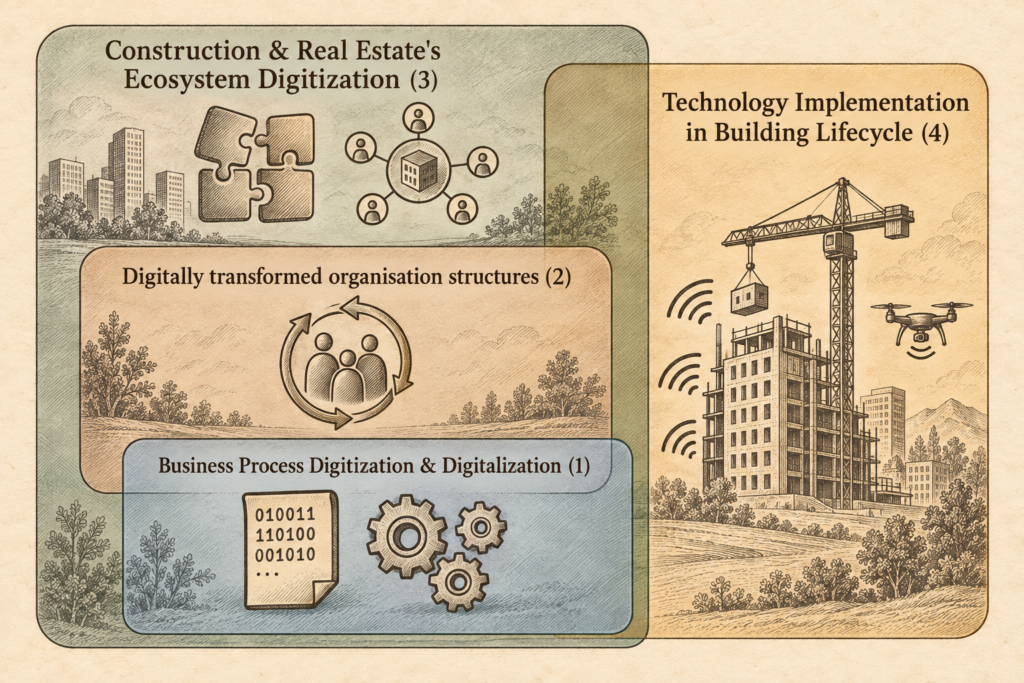
Digital Real Estate is more than an ERP system used to administer lease-in and lease-out contracts. The term covers almost every part of the real-estate industry in which processes, information or transactions are supported by digital technology. Depending on where you work in the industry, that can mean very different things.
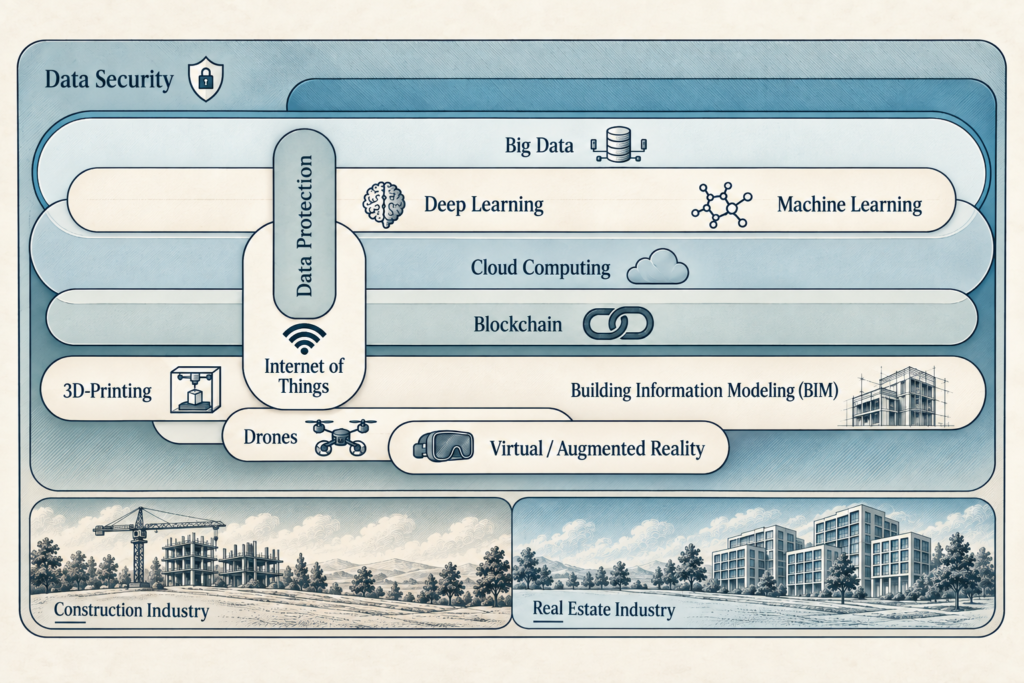
For a real estate developer, Digital Real Estate may begin with project and construction management systems. For brokers, it includes transaction platforms and digital marketplaces. Valuers work with specialised valuation and market-data solutions. BIM has created an entirely new information layer around buildings and has enabled platforms dealing with materials, circularity and sustainability. Digitalisation also reaches into financing, tenant communication and increasingly into interactions with public authorities. All of this can legitimately be called Digital Real Estate.
“The fox knows many things, but the hedgehog knows one big thing.” — Archilochus
But it is not all what we do.
Our expertise is concentrated on the digital core processes of real-estate companies, corporates with substantial owned or leased portfolios, and public-sector real-estate organisations. And in these organisations, one element frequently sits at the centre of the landscape: the real-estate contract. A company leases space in. A landlord leases space out. From that contract follow rent payments, indexation, service charges, notice periods, accounting requirements, documents, compliance obligations and numerous operational processes.
That is where our world starts.
Core
the core area in which we operate most
The contract itself will usually be administered in an ERP or property-management system. But even this apparently simple statement already hides an important distinction.For a real-estate organisation, the operational core does not necessarily have to be a classical enterprise-wide ERP system. It may be SAP. But it may equally be a dedicated property-management platform such as Yardi, Wodis Sigma or GARAIO REM.
Which approach is appropriate depends on much more than software features. Portfolio structure, organisational model, national requirements, finance processes and the surrounding application landscape all matter. Real-estate software is also still remarkably regional: platforms that are deeply established in one market may play a much smaller role only a few hundred kilometres away, while a limited number of products have built a broader international presence.
SAP occupies a particular position in this landscape. Especially in organisations where real-estate processes are tightly integrated with finance, controlling and corporate accounting, SAP has traditionally been highly relevant. The integration of lease administration with IFRS 16 accounting is one obvious example of where this enterprise-wide approach can become particularly important.
But the ERP or property-management system is only the centre of a much larger environment. Documents may reside in a DMS or enterprise-content-management system. Technical building information may be managed through a CAFM or IWMS platform such as Planon or Speedikon. Tenant and landlord communication may run through dedicated applications or portals. CRM, reporting, workflow and finance systems add further layers. For a shopping-centre operator, a corporate occupier and a public property organisation, these landscapes can look fundamentally different — even when all three ultimately manage buildings, spaces and contracts.
This is the area in which we work.
We look at the processes around contracts, spaces, payments and the information connected to them, and at the systems that need to support those processes. From there, our work naturally touches accounting, cash flow, compliance, documentation, interfaces and, where relevant, elements of tenancy law.
why then digital real estate advisory?
We use the term Digital Real Estate Advisory deliberately.
Property management does not take place in a single software application. While property management systems are central to daily operations, they are only one part of a wider digital environment. Property data, contracts, financial processes, documents, reporting, technical operations and communication increasingly move across several connected systems.
A decision made in one application can therefore affect processes and data in many others. For example, changes to a lease or contract may have implications for accounting, document management, reporting, tenant communication or interfaces with CAFM and IWMS solutions.
Our use of the term Digital Real Estate does not mean that we provide advisory services for every technology or software solution in the real-estate sector. It reflects our belief that effective property-management processes must be understood in their wider operational and digital context.
Our advisory services remain focused on our core areas of expertise. However, whenever relevant, we look beyond the boundaries of the property-management application to identify dependencies, improve collaboration between systems and support sound, end-to-end process decisions.
Core
what we do not offer here
Our view of Digital Real Estate extends well beyond our own service portfolio. We know the DACH and wider European market and follow developments ranging from drones in facility management to BIM, PropTech platforms and blockchain-based real-estate applications.
But awareness of a field is not the same as claiming specialist expertise in every part of it.
We are always interested in exchanging ideas about these adjacent areas. Our professional focus, however, remains where we have described it above: the core real-estate processes, their enterprise systems and the architecture connecting them.