

The SAP RE-FX System Health Check for Real Estate Companies is an independent, structured diagnosis of your system environment, helping you evaluate the status of your IFRS 16 implementation and much more.

Find the issue now while it is still cheap to fix.
Sounds familiar?
“Month-end posting completes, but I wait to see how many conditions failed…”
The posting run finishes and I wait — not to see whether errors occurred, but how many there are. A few contracts never post correctly. I have stopped trying to fix the root cause; I maintain a personal list instead. The accounts team even asked me once why I wanted to adjust the debit position. I usually spend eight hours investigating the errors. Sometimes I find the reason. Sometimes I say “I will monitor it next month.” Next month, it might be a different building.
And there is another kind of problem — the ones that do not come from the system itself, but from everything that has been done to it. A migration that nobody validated afterwards. A reorganisation that moved contracts to a new company code, but did so incompletely. A regulatory change that was implemented under time pressure and never reviewed. None of these are bugs. All of them leave traces — small inconsistencies that accumulate quietly until someone notices a number that does not reconcile.
Find the issue now while it is still cheap to fix.
“Is this a deviation, or is this how the system is supposed to work?“
The overall lease liability changes slightly every month. A few hundred euros here, a rounding difference there. I have never established whether this is correct behaviour or something drifting. I asked on a forum once. Someone replied with a SAP Note number. I applied it. The changes kept happening. I assumed it was correct.
There are things in my configuration that I have never touched, because they were already in place when I arrived and they seem to work. One condition type is called “Z_REFX_CNTsomething” — clearly custom, clearly from the original implementation. It runs every month and posts an amount to an account. The account reconciles. I asked the developer: he said it has to do with the BAdI for the indexation. I am not sure I want to know more.
When auditors ask “are you confident this figure is complete and accurate?” I say yes. Inside I am thinking: “I am confident it is produced the same way as last year. Is that the same as being accurate?”ate?”
Find the issue now while it is still cheap to fix.
“I don’t even know what to ask.”
There are reports I do not question. Numbers I do not look into. Not because they appear correct — because I do not know how they are produced. My team tells me they reconcile. I trust them. But the same question, asked twice, sometimes receives two different answers — both reasonable, neither traceable. If the monthly close reconciles, I sign it. What lies beneath the figures is a black box I have learned to live with.
When someone proposes a change — “should we restructure how rent and service charges are posted?” — my first reaction is hesitation. My team is confident it can be done. I have learned that “it can be done” and “we will understand what it costs us downstream” are not the same sentence. How many reports depend on this? What will I have to re-explain to the auditor? I usually set these conversations aside. Not because the question is wrong, but because I cannot estimate the cost of the answer.
I sense that some numbers behave oddly. The service charge accruals look smoother than the underlying data should allow. When I ask, the explanations come — technical, plausible, complete. And yet the gap between what is explained and what I observe does not close. So I let it be. And every quarter I sign off on something I do not fully understand.
“I’ve stopped asking — and built my workarounds around it.”
At some point I stopped asking whether the system is really right, and I started optimising for getting through the month. Admitting that “something fundamental might be wrong” feels like opening a door I cannot close again — investigations, projects, blame, expectations I do not have the capacity to carry. As long as the numbers do not look obviously absurd, they are good enough.
Meanwhile, the system and I grow around each other. My routines, my spreadsheets, my unwritten rules adapt to its quirks. The unusual things become “just how we do it here.” I do not document half of the workarounds, because I remember them. I do not challenge unusual results, because I have internalised the explanation. I have become the missing manual.
The cost of real change quietly grows. Repairing the system would now mean not only changing SAP, but also unravelling years of tacit knowledge and undoing the personal logic I have built on top of it. The system is not just complex anymore — it has become personal. It runs on my memory, my judgement, my workarounds. If I leave, no documentation can replace what I have absorbed. If I stay, I keep paying the cost in silent overhead — every month a little more.
Find the issue now while it is still cheap to fix.
“we`ll need to find out where we actually stand.”
The product
System Health Check
- NDA, read-access, and we begin. Ten days to the report.
- A 2–5 page report in English, German, or French
- At a price small enough not to need procurement’s approval.ent gets pulled in.
Find the issue now while it is still cheap to fix.

“we need more information first. “
(Click the link to read the FAQ, which may require registration.)
Find the issue now while it is still cheap to fix.
“we want to clarify some point before we start.”
(book a 25 min. online session – free)
Find the issue now while it is still cheap to fix.

“we recognize ourselves in the questions.”
(book the ticket: credit card + VAT required)
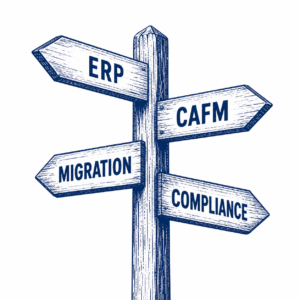
For real estate companies — housing associations, commercial operators, cooperatives